

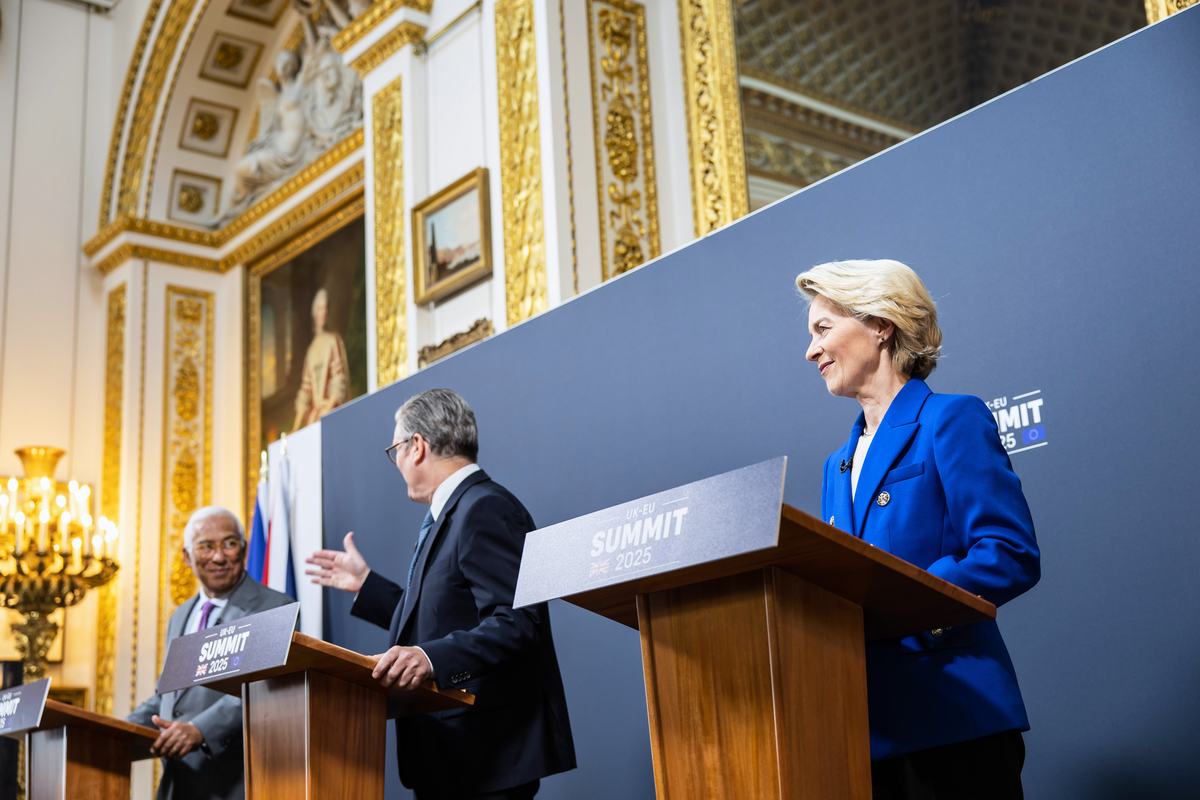
Just over a decade after the 2016 Brexit referendum, the UK and EU find themselves confronting a paradox. Politically, Brexit closed the golden chapter of European integration by ending some five decades of British membership. From a geopolitical point of view, many of today’s challenges are equally facing the UK and the EU. Russia’s invasion of Ukraine, rising transatlantic tensions and concerns over energy security, together with the geopolitical evolutions of the last decade, have fundamentally reshaped the international landscape.
In this context, we believe the case for selective UK-EU cooperation has only grown stronger.
The first years after the Brexit referendum were largely dominated by negotiations over trade agreements and regulatory arrangements. While these issues remain relevant, they no longer represent the most urgent priorities like climate change, energy prices, and security concerns. The UK-EU economic relationship must now be viewed through a broader strategic lens, in which economic cooperation is intertwined with different geopolitical interests.
The limits of economic separation
As the current post-Brexit economic closeness of the UK and EU demonstrates, political withdrawal does not erase the economic structures built through decades of integration, but it can alter them. Our recent research, published in Empirica (Capoani, Barlese and Tudorache, 2025) demonstrates, by applying a gravitational field framework to the European market, a clear destabilising effect caused by Brexit on both the UK and European economic systems.
The consequences of separation are also visible in UK-EU trade. When the UK-EU Trade and Cooperation Agreement (TCA) came into effect in 2021, it prevented the return of tariffs on most goods. It could not, however, replicate the frictionless trade offered by Single Market membership.
The impact is visible in the trade figures: research published in 2024 in the European Economic Review suggests that Brexit reduced goods trade between the UK and the EU by one-fifth, with The Guardian reporting a £6.6 annual trade loss for the UK and €40 billion-€60 billion for the EU.
Trade is only part of the picture; Brexit has shown that economic integration depends on more than the absence of tariffs. Regulatory barriers also matter, particularly between nations whose commercial ties developed over decades.
Brexit in a different world
The world in which Brexit was conceived no longer exists. In part, Western trade policy has for decades acted guided by a belief that deeper economic ties can ease geopolitical tensions. Recent global shocks have exposed the other side of interdependence: dependence on foreign suppliers — an issue that the UK has battled for many decades — can become a source of vulnerability. The pandemic made this problem particularly evident, and Russia’s invasion of Ukraine made it impossible to ignore.
This shift matters for the UK after Brexit. Recent research on UK trade policy shows that economic security and high-tech defence are receiving a widespread increase in attention, from governments to mass media, as geopolitical tensions reshape decisions about trade. Renewed US protectionism has only added to this pressure. In this environment, cooperation with the UK’s largest and closest trading partner becomes harder to dismiss.
Closer cooperation does not involve reversing Brexit. Regulation is one area in which a pragmatic approach could prove useful. Between 1995 and 2022, trade costs within the EU fell by almost 40 per cent, illustrating the economic value of such frameworks which reduce trade barriers between closely integrated economies. In other words, since its establishment in 1993, the European Single Market has been a success.
Since Brexit — which involved the UK leaving the Single Market as well as the EU — the UK has regained the freedom to set its own rules, but divergence from its largest market carries a significant economic cost. Greater regulatory compatibility would not require the UK to follow EU rules across the board, but would allow for an increase in trade flow between the two parties, allowing some advantages of the Single Market to still benefit the UK without official membership. Where differences serve no clear strategic purpose, closer alignment would reduce barriers while preserving regulatory autonomy.
Research already offers a model for this kind of cooperation. The UK formally rejoined Horizon Europe in 2024, allowing British researchers to participate once again on the same terms as those from other associated countries. In the first year of full association, the UK’s share of Horizon Europe funding rose from 5.8 to 9.3 per cent.
The same principle is beginning to shape the relationship in more contentious areas. In May 2025, half a decade after Brexit, the UK and the EU signed a Security and Defence Partnership, acknowledging that their security and prosperity remain closely interconnected. The agreement also covers economic security, with both parties committing to the open exchange of views on their respective policies and addressing of shared risks. We are seeing increasing cases of a post-Brexit UK-EU relationship that frames cooperation as a practical response to common problems rather than a concession of sovereignty. Increasing economic security provides a particularly strong case for this approach, since many of the risks confronting the UK and the EU cannot be effectively addressed in isolation.
Making Brexit work
Despite the political division still surrounding Brexit, there are tangible results suggesting that the settlement could be an advantageous one moving forward. Through their co-operation, British and EU military assistance missions — Interflex and EUNAM respectively — have trained more than 150,000 Ukrainian soldiers, while the 2025 EU-UK Security and Defence partnership, more generally, provides coordination on economic security and the resilience of critical infrastructure.
The emerging model for future EU-UK relations is, thus, neither a return to membership nor a continuation of the distance characterising the first post-Brexit years. Economic interdependence between the EU and UK cannot in fact be erased, while cooperation where both interests coincide appears the more desirable — and sustainable — route.
Looking forward, the task for the EU and the UK is to build a relationship that respects the political choices of 2016 while adapting to the political, economic, social, military and technological realities of today. Andrew Burnham took over 10 Downing Street in July, becoming UK Labour’s latest prime minister. Burnham has said that the EU should again consider options for “Britain’s long-term relationship with our European partners” signalling he would be open to “go all the way”. After a decade of Brexit, the tide may be finally starting to shift.