

Founded by Yevgeny Prigozhin and Dmitry Utkin, the Wagner mercenary group has left its footprint in major international conflicts. Although mercenary groups are illegal in Russia, the group is officially a private, state-funded entity. And it is precisely in this “private status” that Wagner was advantageous to the Kremlin, allowing Russia to extend its influence in conflicts without ever openly declaring its involvement in them. It provides the government with a surplus of experienced, trained soldiers’ whose deaths would not be counted in the official death tolls, thus limiting civic discontent as well as international scrutiny.
After revealing its prowess to the state in Russia’s 2014 invasion of Crimea, the Wagner group became an integral component of Russia’s artillery at the start of Putin’s full-scale invasion of Ukraine, the so-called “Special Military Operation”. What makes the group so special to the Kremlin is that it is largely composed of ex-military soldiers, ex-Spetnaz (Russian special forces), ex-convicts, and members of neo-Nazi and far-right associations. As such, Wagner squads are usually more experienced, trained, and motivated than the average Russian soldier, especially at the beginning of the war in Ukraine, where inexperienced young men having just finished their military service were sent to the front.
Conflict with the Kremlin
It was during the Russo-Ukrainian conflict that disagreements started to emerge between the Kremlin and Wagner leaders. Prigozhin voiced his discontent about the delay in ammunition and other military necessities, and blamed Chief of the General Staff of the Russian armed forces Valery Gerasimov for the deaths suffered by the Wagner group. Growing complaints were raised between the two parties, with Prigozhin voicing his public discontent, stating in April 2023 that Wagner would withdraw their forces from the region if their ammunition demands were not met. Parallel to this escalation of tensions, Wagner received praise from the Russian media and population for their “heroic” action, further accentuating the Kremlin’s inability to monitor the mercenary group.
Ultimately, in June 2023, the Wagner group rebelled against the Russian government and attempted to walk from the Donbass region to Moscow, where they got within 200km of the Russian capital before calling off their march. Russian President Vladimir Putin described the act as a “knife in the back of [the Russian] people.”
In August 2023, Prigozhin, Utkin and 9 other Wagner privates died in a plane crash. The circumstances of their death point to a targeted assassination. The Wagner group was officially dismantled by the Russian government soon after, with most operations and privates absorbed into Africa Corps, a state-controlled mercenary group with targeted missions in Africa. Their name closely resembles the name of the paramilitary Nazi group Afrika Corps, which had similar objectives (helping the Italian forces to control Northern Africa) on the continent.
Wagner’s rebirth in Mali
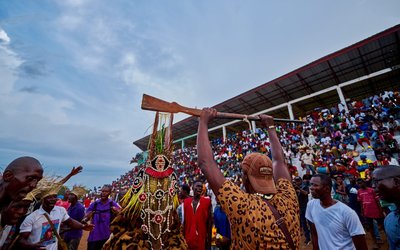
Indeed, the mercenary group has sustained activity in Mali, where it is aiding the government against jihadists groups and pro-independency movements in the northern region of Azawad.
This decision by the Malian government to turn to Wagner for military support came after an overall rejection of French military aid against jihadist groups. The latter were perceived as “not combative enough” by the Malian population, and there was increasing distrust from the Malian government as the French forces created links with the nomad Touareg community, largely present in Algeria, Burkina Faso, Libya, Niger and Mali.
Wagner’s involvement in Mali, however, has been synonymous with open racism, mutilation, torture, murder, humiliation, cannibalism and sexual acts, much like the horrors it committed in Ukraine. These acts are documented and shared on openly racist, far-right and Neo-Nazi Telegram channels monitored by Wagner members present in Mali and followed by thousands of people, where morbid content is proudly shared daily.
One of the most famous channels of the Wagner group is called “White Uncles in Africa +18” and regularly shares abuse content aimed at demonstrating their power and influence in the region. Because of the relatively high free-speech tolerance of Telegram compared to other social media platforms, this type of content can be shared globally without limit, which has led to multiple reports of human rights abuse. If Telegram’s leniency towards the content that can be shared on it was originally intended to be a front against censorship in Russia, its unintended consequence was to become a host for violent, sexual or narcotic content.
It was reported in August 2025 that the Wagner soldiers would be relieved from their positions and replaced with Africa Corps members; but the introduction of Africa Corps privates has not decreased the number of Wagner soldiers on Mali soil, and their role has not changed since.
It is tough to see how the situation will change, and whether a retreat of those hostile forces is possible without jihadist groups taking over in the region. It is also unlikely that those responsible for such atrocities, both perpetrating those acts and/or participating in sharing them on diverse platforms will ever face legal actions against them. Regarding the sharing of the content itself, there is no sign of upcoming regulations. What is for sure is that Wagner’s retreat from collaboration with the Russian government has not led to its disintegration, and that the violence and cruelty it was associated with during its involvement in Ukraine remains a key feature of its operational mode.