If you were to ask why Afghanistan needs saving in the West, I guarantee someone will bring up the burqa. There she is: the Afghan woman covered from head to toe, made to stand for everything supposedly wrong with the country. The image is powerful precisely because it is seemingly self-explanatory. But it conceals the true reasons behind Afghanistan’s descent into authoritarianism.
Fabric has no politics of its own
Veils have been around long before Islam has. And contrary to contemporary representations, veils historically often encoded social status rather than submission. Middle Assyrian law, dating roughly between 1400 and 1100 BC, regulated which women were allowed to cover themselves. The elites and free married women were mandated to wear one; slaves and prostitutes faced public arrest or severe punishments if they were caught veiling. And the practice by no means disappeared with the Assyrians. Women covered themselves in Ancient Greece and Rome, as did ordinary women throughout Christian Europe centuries later. Take a look at the wimple and the kerchief tied under the chin in every peasant painting from medieval Flanders to Tudor England. In Spain and colonial Peru from the 16th to the 19th century, the tapada limena, a garment covering bourgeois women's whole face except one eye, was a symbol of prestige. It allowed them to move through public life on their own terms, away from the surveillance of men, which led the feminist Flora Tristan to claim in 1833 that the bourgeois women of Lima were “the freest in the world”.
Veiling, as such, has no single transhistorical meaning, and neither does its removal. The disappearance of veiling in much of the West is commonly told as a story of progress and enlightenment. Yet changes in Western women’s dress were not just the product of an abstract idea of freedom, but came from a mess of secularisation, fashion, industrialisation, changing gender norms, women’s political emancipation, urbanisation.
Why do we hardly ever grant Afghan women the historical complexity we grant women elsewhere? When we look at a woman in a wimple in 14th-century Bruges, we understand that her clothing belongs to a particular time, religion, class, and set of societal expectations. So why would the burqa lead to the conclusion that Islam defines Afghanistan?
A history of disempowerment
Afghanistan in the 1970s was not a backward country stuck in the past, waiting for its inevitable collapse into extremism. The country had been experimenting with constitutional government, elections and women’s political participation as it ushered in a growing educated class. Although the country’s development was uneven, there was no straight line from the Afghanistan of that era to the Taliban. Everything changed with the arrival of U.S. foreign aid at the end of the decade.
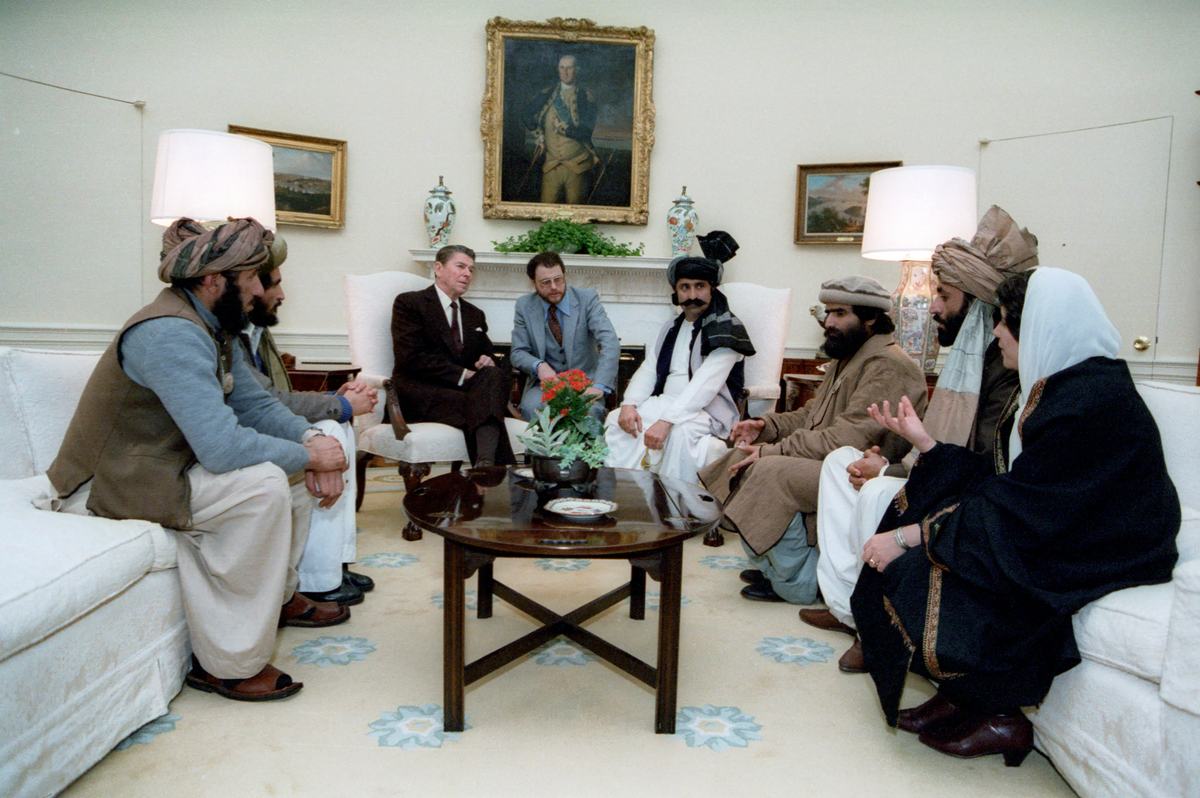
In 1979, the U.S. gave a few hundred thousand dollars in medical and non-military aid every year to Afghanistan. By 1987, they were responsible for pumping in $600mn a year into the nation for Operation Cyclone, the most expensive covert operation in CIA history.But the money did not go straight from Washington to Afghan commanders. It passed through Pakistan’s Inter-Services Intelligence agency (ISI), which largely decided how it would be divided among the different Islamist coalitions. Hardline Islamist factions were among those that the ISI favoured, in part because Pakistan had its own interests in post-war Afghanistan.
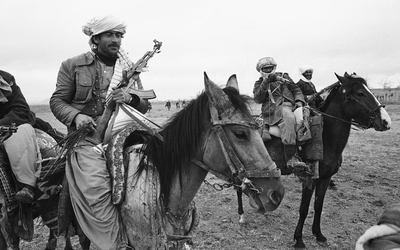
The U.S. meddling with Afghan politics extended beyond financial aid. Between 1979 and 1989, Afghanistan became one of the theatres of the Cold War, the US backing the Afghan government against Soviet troops. Thus, following the USSR’s withdrawal from the country after ten-years of violent conflict, the U.S. left too, leaving the Afghan government with a fractured economy and more importantly, a lack of political direction. Rival mujahideen factions turned on each other, fighting for territory and control of the state.
It was during this civil war that the Taliban appeared in the mid 1990s. They were an Islamist movement, and their beliefs clearly carried weight as to the kind of government they wanted. But wanting to enforce these rules and being capable of doing so are two separate matters. Exhausted by years of brutal factional warfare, many Afghans accepted the Taliban’s severe rule simply for the sake of stability and order.
After 2001, the United States saw in the aftermath of the war they had caused another opportunity for interventionism. The post 9/11 timing was a strategic way for the Americans to position themselves as the vanguard of anti-terrorism. This time, they spent tremendous resources on building a state: elections, ministries, security forces, schools. But the official side of things was only part of how power worked.
The U.S. infiltrated Afghan politics and manipulated it to its own benefit, further ensuring that the Afghan government would never be able to stand on its own two feet after the U.S. inevitably withdrew. The case of Ahmed Wali Karzai, brother of the U.S.-backed president Hamid Karzai and one of the most powerful figures in Afghanistan, aptly illustrates this infiltration, as he simultaneously occupied a central place in the country’s political network while being on the CIA payroll. The 2009 presidential election only confirmed the U.S.’s neglect of political legitimacy in Afghanistan. Indeed, when international observers flagged Hamid Karzai’s victory as fraudulent, the U.S. did not use its influence to insist on a clean vote, preferring to keep its ally in power.
So, when the Americans left for good in 2021, it took just 10 days for the Taliban to regain full, uncontested power. By 15 August 2021, President Ashraf Ghani had fled the country, and the insurgents were inside the presidential palace. Twenty years of international support dissolved with astonishing speed. Whatever it was that foreign intervention had built, it was certainly not a state that could stand on its own. Be that as it may, when people want to talk about what is “wrong” with Afghanistan, the answer still gets reduced back to religion and culture.
Shifting the focus away from Afghanistan
What does collapse do to men, and what does that end up costing women? As Ana Tur-Prats from the Barcelona School of Economics posits, when men in patriarchal societies are deprived of their ability to support their household, they resort to violence as a means of reasserting their authority. In Afghanistan, this trend is evidently visible. As men lost the ability to express themselves through their education and profession, repressing women became a way to grasp as much control as they could still muster. The sociological consequences of warfare reveal that female repression is hence not alone the product of a stricter religious doctrine, but the exacerbation of patriarchal rules in the face of increased economic and political threat.
Spanning from covert operations and military interventions to support for coups and funding armed proxies, US foreign policy does not extend to Afghanistan alone. In countries like Guatemala, Chile, or Vietnam, it also operated according to its own political and economic needs. This makes the need for a “bigger picture” look at Afghanistan all the more relevant.
Afghanistan was Muslim before the Taliban existed, while they ruled, and during the twenty years they were out of power. Islam alone cannot explain why the Taliban’s power changed so drastically while the country’s religion remained. Afghan women’s oppression under Taliban rule is explicit and condemnable. But responsibility does not begin and end with the Taliban. Grieving the women of Afghanistan only when their suffering can be blamed on a politically convenient culprit is hollow. Selective feminism is not feminism. The U.S. has never paid reparations to Afghanistan. The funding shortage is difficult to comprehend considering how, for twenty years, Afghanistan was never too expensive when it was a military priority.
Calling Afghanistan’s collapse a problem of religious extremism is easy because imperialism is a much harder pill to swallow. Freedom for Afghan women won’t come from more discourse about burqas as a symbol of oppression. Foreign governments involved in Afghanistan’s political collapse cannot treat its reconstruction as though they arrived after the fact. Money spent on Afghanistan today is typically classified as aid, as though it comes from Western generosity. After forty years of intervention, the more fitting wording for this is a debt owed.