


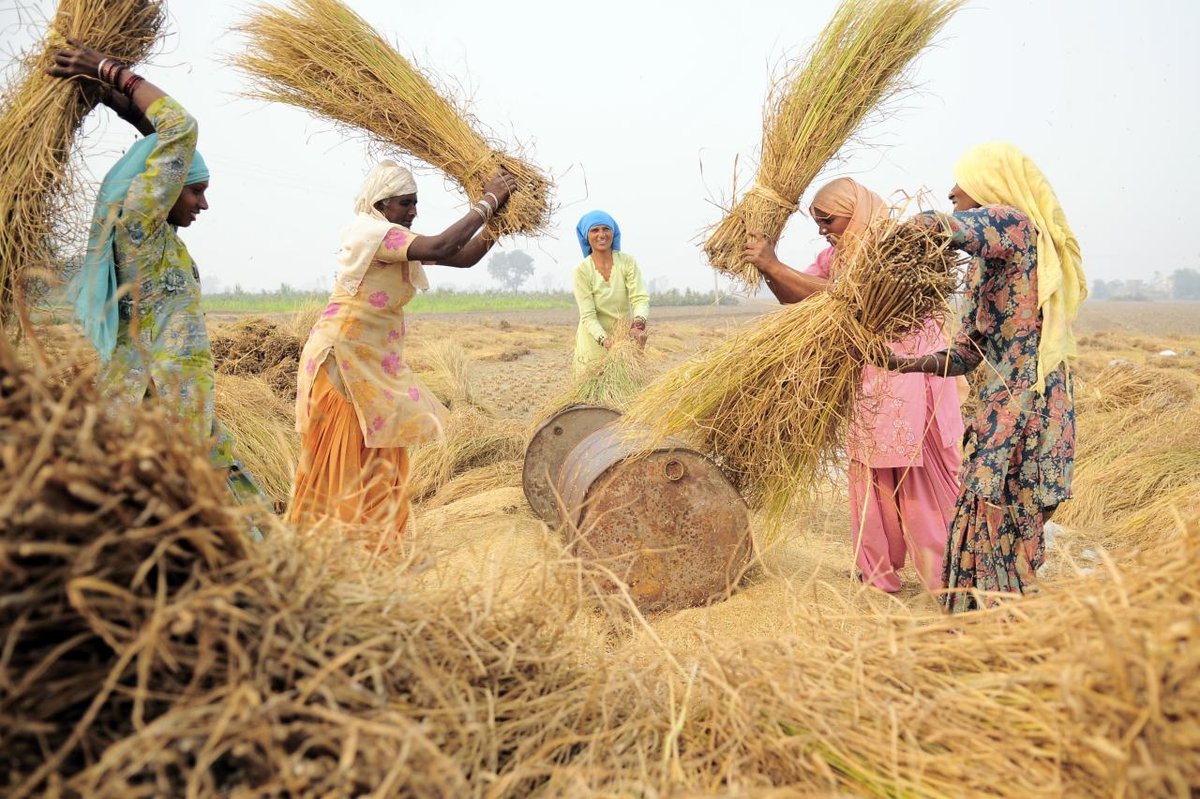
The image of the Indian farmer is simple and deeply ingrained: a man in a field, owning land and directing labour. Repeated often enough, it begins to feel natural. But it is wrong. Across India, those who run farms are increasingly women. Yet they are still not recognised as farmers.
At first glance, this shift in rural labour appears to signal progress. As men migrate to cities, women step in, taking on cultivation, livestock management, and household work. Participation rises, and with it, responsibility. But what looks like empowerment often amounts to heavier burdens — the feminisation of agriculture has shifted agrarian distress onto women’s labour. It reflects how patriarchy adapts rather than retreats: as men leave the land, women take on more of the work, but authority remains structurally male. At the centre of this contradiction lies land.
Land, law and exclusion
In both Indian law and practice, a “farmer” is defined by ownership. As a result, millions of women who cultivate and manage land remain outside this definition, as ownership is typically registered in the names of fathers, husbands, or sons. Without land titles, women are excluded from institutional credit, insurance, irrigation subsidies, and disaster compensation. Since eligibility depends on asset ownership, inequality is effectively built into policy. Data from the India Human Development Survey reflects this structural imbalance: over 80 per cent of land is inherited by men.
The consequences of this become most visible in moments of crisis. A survey by the Mahila Kisan Adhikar Manch found that many widowed, Muslim, and Adivasi women farmers were unable to secure rights to the land they cultivated and, without documentation, were effectively left without access to pensions or compensation for their labour.
Where value is decided
These effects extend beyond ownership. Without access to formal banking systems — including public sector banks and institutions such as the National Bank for Agriculture and Rural Development (NABARD) — many women turn to informal lenders. This reinforces marginalisation and deepens dependency. Rural debt becomes feminised, deepening financial vulnerability and reinforcing gendered hierarchies of control.
Market structures reinforce this exclusion. Agricultural markets and trade networks in India continue to be largely male-dominated. Men handle sales, pricing, and institutional interactions; where value is generated, and women remain invisible and underpaid. According to the 2019 Oxfam India report, in India, women in agriculture earn on average twenty-two per cent less than men, despite comparable levels of labour.
Despite the scale of women’s labour, the imbalance persists. A study by the Food and Agriculture Organisation (FAO) found that on a one-hectare farm in the Indian Himalayas, women contribute 3,485 hours of labour annually—far more than the 212 contributed by men and 1,064 by a pair of bullocks. Ownership rights, control over farm income, and access to markets remain largely male-dominated, constraining the transformation of human labour into tangible economic power. Across developing countries, women produce between sixty and eighty per cent of food. Female participation in Indian agriculture has risen, particularly in farm management roles and labour. Still, only around fourteen per cent of women own land, both figures drawn from FAO data. The result is maximum contribution with minimal control.
The limits of recognition
The same pattern carries from the field into the home. Women bear the bulk of unpaid care work. In India, this invisible labour is estimated to contribute fifteen to seventeen per cent of GDP, as highlighted by Oxfam India. As the 19th-century feminist thinker Flora Tristan described, women are the “proletarian of the proletarian”. They perform both productive and reproductive labour, and are consistently undervalued.
Even where the law has changed, reality has yet to catch up. The Hindu Succession Act of 2005 granted daughters equal inheritance rights to ancestral property. In practice, social norms continue to discourage women from exercising these rights. Policy reflects the same disconnect. Many government programmes targeting women prioritise social welfare, such as savings initiatives like the Sukanya Samriddhi Yojana and the Pradhan Mantri Matru Vandana Yojana, a maternal health scheme, while failing to recognise their economic role as producers.
What’s at stake
FAO estimates that with equal access to productive resources, farm yields could increase by 20–30 per cent, significantly reducing global hunger. Underinvestment in women farmers is unjust and inefficient. Even so, little changes; in a country that prides itself on its agrarian identity, the invisibility of women sends the message that the farmer is celebrated, but she is not recognised.
The marginalisation of women, however, is not uncontested. During the 2020–2021 farmers’ protests against agricultural reforms, women from Punjab, Haryana, and Uttar Pradesh travelled to major protest sites such as Tikri and Ghazipur, not as supporters, but as stakeholders, asserting their role as farmers. “We toil in the fields alongside men. Who are we if not farmers?” one protester asked. Beyond the protests, resistance also takes quieter, symbolic forms. In rural fields, old saris are stretched across the land as makeshift fences, repurposed from their everyday use; their bright colours — reds, yellows, blues — reflect women’s agricultural work: resourceful, adaptive, and largely unseen. There are signs of what becomes possible when recognition aligns with access. In India, the Drone Didi initiative trains rural women to operate agricultural drones, enabling them to manage crop spraying, reduce labour, and generate independent income. In 2026, the United Nations declared the International Year of the Woman Farmer, recognising women’s central role in agrifood systems.
Unless recognition is tied to rights like ownership, credit access, and decision-making power, the feminisation of agriculture will remain what it has long been: labour without legitimacy. When a woman works the land, manages debt, nurtures crops, and sustains her household, what more must she do to be recognised as a farmer? Without change, the farmer, so central to India’s economic and political imagination, will remain, in part, unnamed. How long can a democracy afford to ignore the hands that feed it?