

In March 2022, 175 nations gathered at the UN Environment Assembly's resumed fifth session in Nairobi and made history: adopting Resolution 5/14, mandating negotiations on the world's first legally binding global plastics treaty. The resolution was sweeping in scope — the treaty was to address the full lifecycle of plastics, from petrochemical production to design, use, and disposal. Inger Anderson, the Executive Director of the United Nations Environment Programme, called it the most significant environmental multilateral deal since the Paris Agreement.
An Intergovernmental Negotiating Committee (INC) was established to attempt to finalise the treaty by the end of 2024. After five sessions, the ambitious deadline has passed with no treaty adopted. The talks have been derailed over whether the treaty should address plastic production as well as disposal.
Gridlock
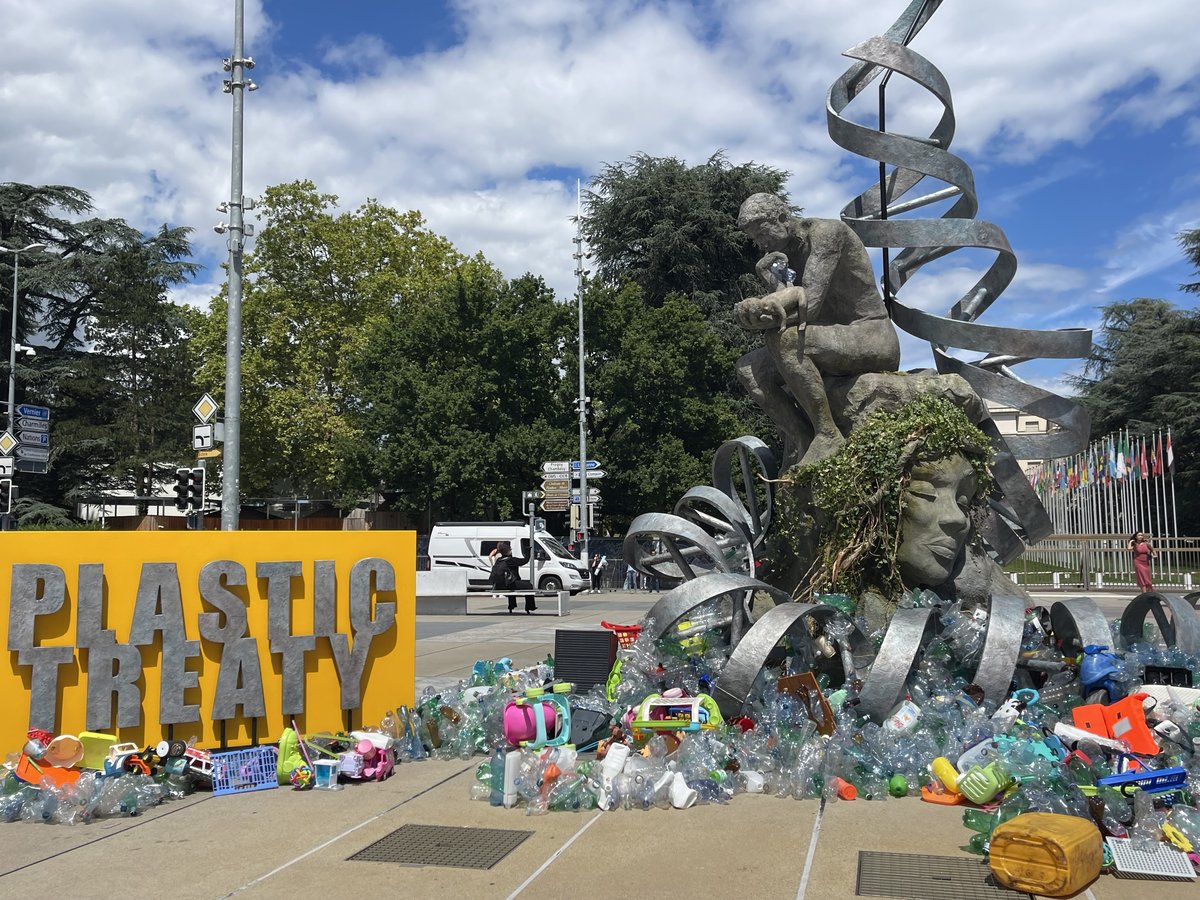
Plastic does not accumulate where it is made but where the infrastructure to manage it does not exist. I am from Egypt, a country home to the Nile, the Mediterranean, the Red Sea and incredibly biodiverse ecosystems. Watching pollution settle into my home is what led me into environmental health work, and it is what brought me to the plastics treaty negotiations over the past two years. Outside the Palais des Nations in Geneva, a six-metre sculpture had been taken down. In 2025, the artist Benjamin Von Wong reimagined Rodin's Thinker seated atop the Earth, cradling a baby, entwined in a strand of DNA. As the INC-5.2 negotiations proceeded inside the building, the sculpture was being engulfed by a rising wave of plastic waste. By the time the sessions ended, the Thinker would be buried.
I have seen multiple rounds of these negotiations, and the sculpture felt true in ways its artist may not have fully intended. Because what strikes you — when enough time has passed in the corridors and contact groups of an INC session — is not the apparent ideological gaps between participants, but something highly nuanced: the weight that every serious negotiator in the building is carrying. The paralysis of Rodin's Thinker is not the paralysis of someone who does not know what is right. It is the paralysis of someone who knows but cannot find the path there.
The formal fault line in the negotiations has become familiar: a coalition of high-ambition countries (chaired by Norway and Rwanda) pushing for production cuts and upstream obligations versus a group of countries holding firm on a downstream scope focused on the waste management of plastic pollution.
The High-Ambition Coalition asks countries at vastly different levels of industrial development to accept the same upstream obligations. Paradoxically, production limits are being proposed primarily by countries with the institutional infrastructure and capital to implement alternatives in a world that includes many countries without either. When those proposals arrive unaccompanied by binding technology transfer, concessional financing, or differentiated transition timelines, the burden lands unevenly. The principle of Common But Differentiated Responsibilities (CBDR), enshrined in the Rio Declaration (and foundational to climate governance for decades) has not been written into the operative text of this treaty with any force. For many delegations, that absence is a point of contention.
On the penultimate day of INC5.2 in Geneva, I sat in the lobby of one of the hostels by Lake Geneva with nine other young people from eight different countries: Egypt, Brazil, Germany, the Philippines, Mexico, Kenya, the U.S. and Tanzania. We were observers, not delegates. We had no formal role in the process, and had spent the previous days watching the deadlock harden.
We opened a shared document and built a simple table. Two columns for the two main positions. An empty column in the centre, labelled “bridge”. Then a row for each of the treaty's critical articles. It took us three hours and we were not always in agreement. We came from different regions with different stakes. But we made space to hold different views, to try, genuinely, to put ourselves in the position of the member states — to understand not just what each side wanted but why, and what movement might actually be possible.
We shared what we had produced in corridor conversations with some friendly delegations in the days that followed. The reaction from one experienced delegate has stayed with me: “This is exactly what the INC should have done.”
I am not suggesting that ten young observers had found what professional negotiators had missed. I was simply impressed that the exercise was possible at all: that sitting with the genuine complexity of both positions, without the institutional pressures that make movement politically costly, produced something. The missing ingredient was the space to look for a bridge without the pressure to protect relative positions. That is partly why the role of bridging countries in these negotiations deserves more attention and more deliberate support at INCs.
What we can do
Bridging countries tend to operate in the margins of the formal architecture, running on goodwill and bilateral trust rather than on structured mandates. There is a gap in formal recognition of their role to channel their work back into the chair's text-building process. At INC-5.2, the extended final day was marked by precisely the kind of chaos that emerges when informal bridging capacity is overwhelmed.
Delegations with the largest teams and resources were able to organise their own informal discussions and maintain influence. Smaller delegations, including many of those most exposed to plastic pollution, struggled to stay in the conversation at all. In my opinion, what the process needs are these three recommendations:
First, any interest to improve production and upstream measures must be matched by equally binding implementation support (i.e., technology transfer, concessional financing, and capacity building) that are realistic, not aspirational. The principle of CBDR must appear in the operative text of this treaty, not buried in its preamble.
Second, the treaty must be honest about what it is protecting against: the myriad ways in which plastic pollution harms communities, ecosystems, and human bodies as documented by science. A treaty that does not create a mechanism to progressively identify and address those harms is not fit for purpose. The standards can be developed through scientific committees and future COPs, as has been done under other multilateral environmental agreements.
Third, more countries need to step into the space between the dominant positions and the process needs to actively support them when they do. The newly elected chair, Julio Cordano, has vocalised “the importance of finding common ground to enable countries to move forward together and achieve a meaningful agreement.” The intersessional period until the next INC session is a fertile opportunity for champion countries to build bridges between the fault line positions and try to support the chair to find that common ground.
The treaty will not be judged by its stated ambition or the comprehensiveness of its provisions, but whether it answers the question Rodin and Benjamin Von Wong asked: can we create the conditions under which change becomes possible? Years from now, its measure will be whether the communities most harmed by plastic pollution can point to something that truly changed. That outcome requires the more difficult, less visible work of countries willing to build bridges and having the processes to support them.