

The myth of Slavic parents is not abstract. However, it is an unkind one, especially considering the historical perspective of the opportunities our parents had versus us. My parents’ generation saw the world open up before their eyes and then, effectively, everything they thought to be set in stone about building a good career change.
The struggles of our parents
In 1989, the communist regime of the Polish People’s Republic came to an end. The following liberalization of the economy in the 1990s came with financial cuts to the public sector, including education. Physical jobs were no longer able to pay for whole families; young people, instead of following in their parents’ footsteps, would start their own businesses or pursue careers that were both highly skilled and required lengthy educational processes.
With decentralisation came the devaluation of teaching professions, something my mother was told by my grandfather that she could always fall back on for employment. The communist government had made sure to espouse jobs valuing collective prosperity and service to the people. Academia, thus, was something to pursue for passion, but definitely not for money. Everything was uncertain — the life imagined by the youth thus far came crashing down with reality.
Before my parents’ time, my maternal grandmother wanted to study the Polish language. My paternal grandmother dreamt of becoming an economist. Neither of them got to do that, but they always mentioned being grateful that they did not have to work jobs that required physical labour like their siblings. One worked in administrative positions at a government-owned cooperative for disability aid and the other at a local municipality office, respectively. My maternal grandmother would always explain her sister’s complaining as a result of her job being hard and her body being affected by it, while my paternal grandmother would explain her brothers’ bad life choices by the fact that they were not well educated. Comparatively, my grandmothers were the ones, within the approximately six siblings each of theirs, that made it.
My mother, years after the previous generation had hit the wall when trying to go beyond possessing secondary education, had to fight hard to attend a university and attain a master’s degree in Polish linguistics. She had to finish vocational high school, which allowed her to work as a Polish language teacher. If she were to pursue higher education, she had to make sure that she had a job to fall back on, an ultimatum given to her by her father.
Closed doors
My mother’s story and the generational longing for academic pursuit are not unique to hear from someone coming from Poland in the late 1980s and early 1990s. Depending on social standing, most of the labour force during that time could be described as working class. They worked physically or had entry-level jobs with no specific requirements. They would earn just enough to lead a decent but modest lifestyle. Most of them were also generally at peace with that.
But, alongside that, there were also a lot of quietly frustrated women, many of whom were told by their teachers, fathers, brothers, and friends that their dreams should not and will not be realised. That, to support themselves and more importantly, their future family, they should choose a practical career. Very commonly, they would just be informed of what it is that they will sacrifice their life to for the next forty to fifty years.
From what I heard through stories told by my family members, a job opportunity would often arise via family or friends' connections. During the transition from communist to democratic Poland, anyone turning down any job opportunity would be considered a moron. Many young people, including my parents, emigrated exactly because of the lack of decent work opportunities for them, despite having qualifications and higher education. The work environment of communism was not a kind one for women. Just before leaving, my mother, in possession of a master’s degree in Polish linguistics and pursuing a postgraduate degree in journalism, had been working behind the counter at a butcher shop.
No relief for Slavic women
When I began applying for universities, I began to notice that my mother would not allow any slacking off. She expected me to prepare a document listing all the universities that I was interested in alongside important application deadlines. As a seventeen-year-old who was never taught to shut her mouth, I saw it all as a ridiculous, banal procedure, but still one that somehow made my mother sure I would have a stable career and future. I crossed off the things to do in order for my mother to shut it and let me be.
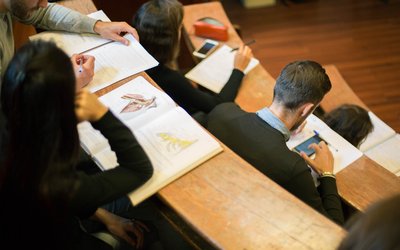
During my first year, I was trying to survive the pressure of both my parents and the Dutch system at Leiden University, where if you don’t obtain enough credits, you get kicked out and are unable to reapply to any university programme. It suddenly felt as if I had two pairs of Eastern European parents looking at me from above, calling me on FaceTime after every grade I received. At the same time, the system is focused on individualism and time management. My academic life had suddenly turned 180 degrees, where it was no longer the case that other people were in control of my time or, more importantly, my future.
In my third year, I found grounding. I realised who I am and what not to take from my parents. It takes a lot to understand some of the motives behind Eastern Europeans parents’ actions, but my overall takeaway was that it all came from a place of care. With a great amount of confidence, I can say that my mother’s excessiveness is what landed me in the place I am in my life right now, having a nearly completed bachelor's degree at a highly prestigious Dutch university and beginning an internship at an international NGO. It is not something people from, let's say, the Netherlands will find understandable, let alone normal. This is what you get from attending therapy and making mistakes for which you pay a high price.
Moving out to a foreign country at eighteen from this cultural background has been life-changing. I managed to see different work cultures and different approaches to career life. The Dutch would finish their work and go out to have drinks, not worried about their 9 to 5 outside work hours. If you wanted to do something, you could just do it; you did not have to consider any opportunities wasted just because your career choices did not align with your relatives' vision for you. I began to breathe for the first time since my senior year of high school. Establishing a balance is hard when you are suddenly free and on your own.
I know it is hard for both sides. You want to please your parents, knowing what they went through getting their degrees, and establishing themselves professionally. The good thing is that we also get that, only with more space to maneuver. We are drawing new boundaries. Polish women, often the second, if not the first, generation to earn a higher education degree, are making history as we speak. Just let them all have fun and take a breather while they do so, okay?