
I can still remember the first time I saw The Matrix (1999): slightly terrified, age nine, hiding under a blanket. There was something chilling and captivating about the world as we know it destroyed and unrecognisable. Why is that?
Early manifestations
Stories about the end of the world are as fascinating to us and our TV-addled imaginations as they were for previous generations. It is particularly fascinating to consider how the question of the apocalypse is explored through fiction, as these reflect the author's imaginations, anxieties and desires.
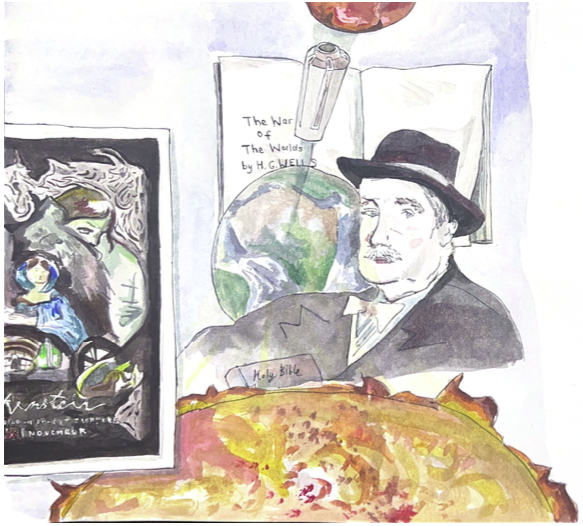
British novelist Herbert George Wells was born into industrial England in 1866. I cannot imagine that anyone who witnessed his youth could have sensed the hundreds of novels and essays brewing behind his serious, reserved demeanour. Alongside detached Martian heads invading London before dying of the common cold (The War of Worlds, 1898), his vivid storytelling featured weird time machines going way too far into the future (The Time Machine, 1895).
Unlike his characters, Wells himself was uninterested in travelling to the future or escaping reality. His work was preoccupied with the present. He was terrified of the supposed intellectual decline of London society at the time, as he wrote in his book The Outline of History (1920): “Human history becomes more and more a race between education and catastrophe.” And according to Ailise Burfin’s 2015 dissertation, “The Natural Catastrophe in Late Victorian Popular Fiction”, Wells ultimately believed that presenting his readers with violent apocalyptic imagery could help them understand the potential threats the Industrial Revolution could have on the planet.
Other science fiction authors like Mary Shelley and Jules Verne also felt the cusp of their old-world order collapsing, with the sheer brute force of science discrediting the previously absolute power of religion. It was these preoccupations that gave birth to The War of the Worlds (1898), Frankenstein (1818), Journey to The Centre of the Earth (1864), and the science-fiction genre as we know it.
Enduring influences
There are several trends from the first science fiction that are survived by today’s bestselling dystopian novels. I find it interesting how in order to connect to powerful, abstract ideas of the world ending, many stories utilise a single first-person narrator to recount events as retrospective witnesses. These narrators are also the protagonists, and, although they do not have a superior power or understanding of events, they manage to miraculously survive the duration of the book. This is also the case in dystopian scenarios. Think of Offred in Margaret Atwood’s The Handmaid’s Tale, the narrator who manages to survive a world that treats her like an incubator despite being just an ordinary woman. Perhaps through the protagonist’s survival, this narrative form may provide a sense of comfort and paradoxical order to balance the threats of the terrifying realities depicted in these works.
Religious influences have been one of the most enduring motifs shaping apocalyptic storytelling, providing narrative structure as well as clear imagery that is ubiquitous. Regardless of whether you realise it, most readers are certainly familiar with the book of Revelation, the last book in the New Testament, attributed to John of St. Patmos in 95-96 CE. Though lacking Martians, this end-of-times scenario features all-powerful lambs, war horses, beasts, idiots, snakes, and the ultimate salvation of Christian believers. Even Wells — who was equally enthralled with and suspicious of religion — admits himself how much his vivid style was influenced by his study of the Bible early in life. Despite the limitless interpretations and alterations of the Bible throughout history, I was particularly impressed by one core concept: the biblical notion of “revelation”.
The word ‘revelation’ is a translation of the Greek word apokalypsis (Greek being the language in which the New Testament was originally written). Thus, both “revelation” and “apocalypse” derive from the same Greek word. This suggests that the book of Revelation does not merely attempt to predict the end of the world, but rather “uncovers” a previously hidden meaning within it to its readers, which has a final, lasting metaphysical significance. In the context of the Bible, this notion of revelation frames catastrophic events as evidence of “divine order” and divine intervention of God in human history, as opposed to random destruction. By guiding audiences towards a particular interpretation of disaster, it encourages readers to adopt the Christian faith.
The actual apocalypse
Yet sometimes it is hard to tell what is actually real as opposed to what we have accumulated through fiction. Since 1949, “The Doomsday Clock” has been set every year by the Bulletin of the Atomic Scientists, a non-profit organisation, to communicate their concerns of possible global destruction through human technologies, initially nuclear weapons, now also artificial intelligence and other biological threats. The closer the clock is set towards midnight, the closer we are to a global point of no return and a potential end to human existence. Breaking last year’s record of eighty-nine, the 2026 clock is turned to eighty-five seconds before midnight.
Whilst international relations are complex — existing in dense networks of power relations and exchanges — and individual human lives are more intricate than we would expect, it is new technological forces that have the power to flatten entire nations, in both a metaphorical and physical sense. In a time teetering on extremist ideologies, an increasing gap in living standards, and blatant human rights violations visible on our social media apps, have we developed an adequate global moral and legal framework for these technologies? Amid these continuously accelerating changes, it is impossible to ignore and difficult to reconcile with the idea that we as individuals may also be participating in this large-scale destruction.
At the same time, it is a fact that life on Earth will end at some point in the seemingly endless future of the universe, though perhaps through something entirely non-human: asteroid impact, deoxygenation, gamma ray bursts, or the end of the Sun. Still, this does not stop us from considering threats to our own mortality in a human way through narrative frameworks, such as books and films.
Part of what makes the apocalyptic imagery so powerful is that it allows us to decide who “the saviour” is and who is responsible for ending the world. The division between forces of salvation and destruction — those who are good or evil — removes a sense of the impersonal, or randomness, from destruction. By lending even catastrophe an illusion of human significance, it allows us to imagine that we have the capacity to understand it. It is utterly terrifying to imagine that an end to humanity might not include a higher power or us, ourselves, and thus be entirely separate from human influence.
This question is clearly among those that we cannot answer until they have happened: how will the world end? Rather, like Wells, we can continue to use our imagination in another vastly uncharted territory, which, though often privately explored, has reverberated in the collective consciousness for millennia: fiction. We should try to understand better the world we are living in now; the one we still have.