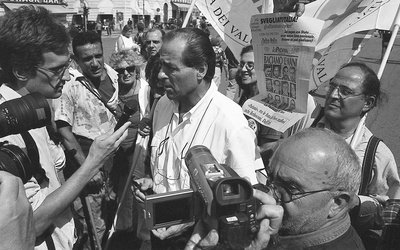

German literary critic Anna Vollmer began her contribution at the 2024 edition of the Mantova Festival Letteratura with: “If a German had to think about Italy without ever having been there, and so had, as a spectrum of analysis, contemporary books, they would surely believe that it is a country populated by old women, witch-like, still dwelling in marble graves.” Then she adds with wit: “Instead, Italy does have refrigerators!” A general laugh arose from the audience.
Anna Vollmer’s work is mainly focused on Italian literature for the Frankfurter Allgemeine Zeitung and her statement goes far beyond a merely ironic and unrealistic snapshot of today’s publications. Aside from autofiction and memoirs’ literary domination, the tyranny to which Vollmer is referring to is another: the fear of the present. To be fair, it is a disease rather than a lowly despotism.
Slanting towards the past
The cult spread: Antonio Scurati published Mussolini: Son of the Century (2018). Figures once bound to history books have turned into a historical TV drama. Scurati is now a writer and a journalist engaged in facing and fighting, through literature, the manipulative language distortions led by authoritarians. With his career between university desks, teaching the semiotics of war and violence, Scurati’s accuracy subverts any possible trivial “fascination of the evil” we, as humans, might come across. The international bestseller he delivered relentlessly chronicles the emboldened, deviant birth and rise of fascism in Italy through the figure of Benito Mussolini. By the same month in which the pentalogy finished its release, Scurati was no longer welcomed to read his speech for Liberation Day on the state network due to “editorial reasons” according to The Guardian. By May, Joe Wright’s series adaptation was already on every television.
This year, the twenty most read titles of Italian narrative are set in the past or are historic retellings. Italian publishing houses are releasing a plethora of publications, which appear stuck in a non-perfectly definable past, as this past is not even a time anymore, but rather a concept. Critics are facing a literary era where the present is paradoxically narrated and conceived through the past, sometimes the future, but mainly the former, as making up an event which has not occurred yet is more engaging than describing unchallenged an unalterable reality.
The conservative slant Italy is embracing is blatantly mirrored in readers’ historical-nonfiction preferences. This does not bring the conclusion that contemporary literature is diverting towards a die-hard skew, but leads to visualising the contemporary incapability of understanding the present. Writing in a time where expectations coincide with the reality of facts, a reality which leaves no room for unpredictability, empower writers and readers to regain the protagonism they have lost in daily and political living.
Cowards in the face of the greats
Distance gives the authour the sly certainty of not failing, the cowardly reassurance of owning all the necessary intellectual tools to narrate a present, the one chosen for the story, which is, in a twist of fate, still a past. The logic behind this is the socio-cultural idea of an incapability to understand the present, and this ‘Made-in-Italy’ myth is as dusty as the birth of literature itself. The Iliad and the Odyssey, when were they set? Were they set when Plato was witnessing Socrates’ death? No. Were they set when Athens was fighting against Sparta? Neither. They were actually set when time was not yet a concept but when men felt ripe enough — and it is all about ripeness, as Shakespeare points out — to tell the story almost four hundred years later.
The present-phobia which has engulfed Italy and the writers’ and readers’ cravings for historic-shelter readings show another consequential manipulation of today’s art’s meaning: the pathological, Easter-like rush for eggs among the bushes in the need to winnow out a lesson from art. As if art had to teach something to earn the right to exist. As if man could embrace art only to learn a lesson for the present.
The brave examples I could mention are several, but recently I made myself the mere aesthetic gift of reading Lolita again. Vladimir Nabokov published Lolita in 1955, the story of a pervert who loves and fantasises about a child in the American Fifties. Nabokov wrote Lolita because he wanted to, because he was interested in the narrative process of imagining and scribbling a pervert. Lolita is the example of how much literature has all the right to be useless, and how overtiring the interminable questions are about the whys behind a piece of art. The reacquisition of contemporary agency starts from the demystification of Meaning.